Posts

CHAPTER 15: OUTSOURCING

Image
Outsourcing Outsourcing Projects: insourcing (in-house-development) - a common approach using the professional expertise within an organization to develop and maintain the organization's information technology systems outsourcing - an arrangement by which one organization provides a service or services for another organization that chooses not to perform them in-house onshore outsourcing - engaging another company within the same country for services nearshore outsourcing -  contracting an outsourcing arrangement with a company in a nearby country offshore outsourcing - using organizations from developing countries to write code and develop systems big selling point for offshore outsourcing "inexpensive good work" factors driving outsourcing growth include: core competencies  many companies have recently begun to consider outsourcing as a means to fuel revenue growth rather than just a cost-cutting measure financial savings it is typically...

CHAPTER 14: CREATING COLLABORATIVE PARTNERSHIPS

Image
Creating Collaborative Partnerships Teams, Partnerships, and Alliances: organizations create and use teams, partnerships, and alliances to: undertake new initiatives address both minor and major problems capitalize on significant opportunities organizations create teams, partnerships, and alliances both internally with employees and externally with other organizations collaboration system -   supports the work of teams by facilitating the sharing and flow of information. organizations from alliances and partnerships with other organizations based on their core competency core competency - an organization's key strength, a business function that it does better than any of its competitors  core competency strategy - organization chooses to focus specifically on its core competency and forms partnerships with other organizations to handle nonstrategic business processes information technology can make a business partnership easier to establish and manage i...

CHAPTER 13: CREATING COLLABORATIVE PARTNERSHIPS THROUGH E-BUSINESS

Image
Creating Collaborative Partnerships Through E-Business E-Business: the internet is a powerful channel that presents new opportunities for an organization to: touch customers enrich products and services with information reduce costs how do e-commerce and e-business differ? e-commerce - the buying and selling of goods and services over the internet e-business - the conducting of business on the internet including, not only buying and selling, but also serving customers and collaborating with business partners E-Business Model: E-business model - an approach to conducting electronic business on the internet Business-to-Business (B2B): Electronic marketplace (e-marketplace) - interactive business communities providing a central market where multiple buyers and sellers can engage in e-business activities Business-to-Consumer (B2C): common B2C e-business models include: e-shop - a version of a retail store where customers ca...

CHAPTER 12: INTEGRATING THE ORGANIZATION FROM END TO END-ENTERPRISE RESOURCE PLANNING

Image
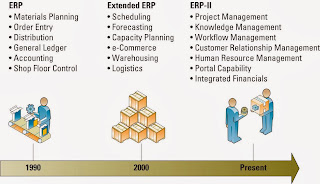
Chapter 12:  Integrating The Organization From End To End-Enterprise Resources Planning Enterprise Resource Planning (ERP): at the heart of all ERP systems is a database, when a user enters or updates information in one module, it is immediately and automatically updated throughout the entire system  ERP systems automate business processes Bringing the organization together: ERP - the organization before ERP ERP - bringing the organization together Integrating SCM, CRM, and ERP: SCM, CRM, and ERP are the backbone of e-business. integration of these applications is the key to success for many companies. integration allows the unlocking of information to make it available to any user, anywhere, anytime. Integration Tools: many companies purchase modules from an ERP vendor, an SCM vendor, and a CRM vendor, and must integrate the different modules together middleware - several different types of software which sit in the mi...

CHAPTER 11: BUILDING A CUSTOMER-CENTRIC ORGANIZATION-CUSTOMER RELATIONSHIP MANAGEMENT

Image
Building A Customer-Centric Organization-Customer Management Customer Relationship Management (CRM): CRM enables an organization to: provide better customer service make call centers more efficient cross sell products more effectively help sales staff close deals faster simplify marketing and sales processes discover new customers increase customer revenues Recency, Frequency, and Monetary Value: organizations can find their most valuable customers through "RFM" - Recency, Frequency, and Monetary Value how recently a customer purchased items (Recency) how frequency a customer purchased items (Frequency) how much a customer spends on each purchase (Monetary Value) The Evolution of CRM: CRM reporting technology - help organizations identify their customers across other applications CRM analysis technologies - help organization segment their customers into categories such as best and worst customers CRM predicting technologies - help organiz...

CHAPTER 10: EXTENDING THE ORGANIZATION-SUPPLY CHAIN MANAGEMENT

Image
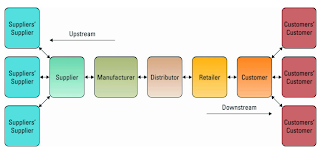
Extending The Organization-Supply Chain Management Supply Chain Management: the average company spends nearly half of every dollar that if it earns on production. in the past, companies focused primarily on manufacturing and quality improvements to influence their supply chains. Basic of Supply Chain: the supply chain has three main links: material flow from suppliers and their "upstream" suppliers at all levels transformation of materials into semi finished and finished products through the organization's own production process distribution of products to customers and their "downstream" customers at all levels organizations must embrace technologies that can effectively manage supply chains. Information Technology's Role in the Supply Chain: it's primary role is to create integrations or tight process and information linkages between functions within a firm factors driving SCM Visibility: supply ch...

CHAPTER 9: ENABLING THE ORGANIZATION - DECISION MAKING

Image
Enabling The Organization - Decision Making Decision Making: reasons for the growth of decision-making information systems people need to analyze large amounts of information people must make decisions quickly people must apply sophisticated analysis techniques, such as modeling and forecasting, to make good decisions people must protect the corporate asset of organizational information Model - a simplified representation or abstraction of reality IT systems in an enterprise Transaction Processing Systems: moving up through the organizational pyramid users move from requiring transactional information to analytical information. Transaction processing system - the basic business system that serves the operational level (analysts) in an organization. Online transaction processing (OLTP) - the capturing of transaction and event information using technology to (1) process the information according to defined business rules, (2) store the informat...

CHAPTER 8: ACCESSING ORGANIZATIONAL INFORMATION-DATA WAREHOUSE

Image
Accessing Organizational Information-Data Warehouse Data Warehouse Fundamentals: Data warehouse - a logical collection of information - gathered from many different operational databases - that supports business analysis activities and decision-making tasks. the primary purpose of a data warehouse is to aggregate information throughout an organization into a single repository for decision-making purposes. Extraction, information, and loading (ETL) - a process that extracts information from internal and external databases, transforms the information using a common set of enterprise definitions, and loads the information into a data warehouse. Data mart - contains a subset of data warehouse information.  Multidimensional Analysis and Data Mining: databases contain information in a series of two-dimensional tables. in a data warehouse and data mart, information is multidimensional, it contains layers of columns and rows Dimension - a particular attribute of i...

CHAPTER 7: STORING ORGANIZATIONAL INFORMATION - DATABASES

Storing Organizational Information - Databases Relational databases fundamentals: information is everywhere in an organization. information is stored in databases. Databases - maintains information about various types of objects (inventory), events (transactions), people (employees), and places (warehouses). database models include: Hierarchical database model - information is organizad into a tree-like structure (using parent/child relationships) in such a way that it cannot have too many relationships. Network database model - a flexible way of representing objects and their relationships. Relationship dataase model - stores information in the form of logically related two-dimensional tables. Entities and Attributes: Entity - a person, place, thing, transaction, or event about which information is stored. Attributes (fields, columns) - characteristics or properties of an entity class. Keys and Relationships: primary keys and foreign keys identi...

CHAPTER 6: VALUING ORGANIZATIONAL INFORMATION

Valuing Organizational Information Organizational information: information is everywhere in an organization. employees must be able to obtain and analyze the many different levels, formats, and granularities of organizational information to make decisions. successfully collecting, compiling, sorting, and analyzing information can provide tremendous insight into how an organization is performing. levels, formats, and granularities of organizational information. The value of transational and analytical information:  transactional information verses analytical information. The value of timely information: timeliness is an aspect of information that depends on the situation. Real-time information - immediate, up-to-date information. Real-time system - provides real-time information in response to query requests. The value of quality information: business decisions are only as good as the quality of the the information used to make the  decisio...

CHAPTER 5: ORGANIZATIONAL STRUCTURES THAT SUPPORT STRATEGIC INITIATIVES

Organizational Structures That Support Strategic Initiatives Organizational Structures Organizational employees must work closely together to develop strategic initiatives that create competitive advantages. Ethics and security are two fundamental building blocks that organizations must their business upon. IT Roles and Responsibilities Information technology is a relatively new functional area, having only been around formally for around 40 years. Recent IT-related strategic positions: Chief Information Officer (CIO) Chief Technology Officer (CTO) Chief Security Officer (CSO) Chief Privacy Officer (CPO) Chief Knowledge Officer (CKO) Chief Information Officer (CIO): oversees all uses of IT and ensures the strategic alignment of IT with business goals and objectives. Broad CIO functions include: Manager- ensuring the delivery of all IT projects, on time and within budget. Leader- ensuring the strategic vision of IT is in line with the strat...

CHAPTER 4: MEASURING THE SUCCESS OF STRATEGIC INITIATIVES

MEASURING THE SUCCESS OF STRATEGIC INITIATIVES Measuring Information Technology's Success Key performance indicator - measures that are tied to business drivers. Metric are detailed measures that feed KPIs Performance metric fall into the nebulous area of business intelligence that is neither technology, nor business centered, but requires input from both IT and business professionals Efficiency and Effectiveness Efficiency IT metric - measures the performance of the IT system itself including throughput, speed, and availability Effectiveness IT metric - measures the impact IT has on business processes and activities including customer satisfaction, conversion, rates, and sell-through increases Benchmarking-Baselining Metrics Benchmarking - a process of continuously measuring system results, comparing those results to optimal system performance (benchmark value), and identifying steps and procedures to improve system performance  E-government benc...

Chapter 3: STRATEGIC INTIATIVES FOR IMPLEMENTING COMPETITIVE ADVANTAGES

Strategic Intiatives For Implementing Competitive Advantages organizations can undertake high-profile strategic initiatives including: supply chain management (SCM) customer relationship management (CRM) business process reengineering (BPR) enterprise resource planning (ERP) Supply Chain Management (SCM)  involves the management of information flows between and among stages in a supply chain to maximize total supply chain effectiveness and profitability four basic components of supply chain management include: Supply chain strategy - strategy for managing all resources to meet customer demand Supply chain partner - partner throughout the supply chain that deliver finished products, raw materials, and services. Supply chain operation - schedule for production activities Supply chain logistics - product delivery process Effective and efficient SCM systems can enable an organizaion to: decrease the power of its buyers increase its own supplier power ...

CHAPTER 2: IDENTIFYING COMPETITIVE ADVANTAGE

MGT300 Chapter 2: Identifying Competitive Advantage  Explain why competitive advantages are typically temporary. List and explain each of the five forces in Porter's Five Forces Model. Compare Porter's three generic strategies. Describe the relationship between business processes and value chain. What is competitive advantage? A product or service that an organization's customers place a greater value on than similar offerings from a competitor. Unfortunately, CA is temporary because competitors keep duplicate the strategy. The, the company should start the new competitive advantage.  FIVE FORCES MODEL Buyer Power:  High- when buyers have many choices of whom to buy Low- when their choices are few. To reduce buyer power (and create competitive advantage), an organization must make it more attractive to buy from the company not from the competitors. Best practices of IT-based Supplier Power High- when buyers have few choices of whom...